Heavy rainfall is becoming a major concern for property owners across Montreal. During intense storms, large volumes of rainwater can enter municipal sewer systems within a short period, sometimes exceeding their capacity.
For owners of older duplexes, triplexes and buildings with flat roofs, this creates a particular challenge: rainwater collected on the roof may be discharged into the same sewer system that carries wastewater from the building.
When municipal sewers become overwhelmed, water can back up toward connected properties, increasing the risk of basement flooding.
As a result, some Montreal homeowners are exploring ways to divert rainwater from their flat roofs instead of sending it directly into the existing sewer connection.
But what does diverting a flat roof drain actually involve? Where can the rainwater go? And which solutions are practical for older Montreal buildings?
Let's explore the different approaches property owners are considering to reduce the amount of roof rainwater entering overloaded sewer systems.
1. Why Montreal Homeowners Are Looking at Flat Roof Drain Diversion
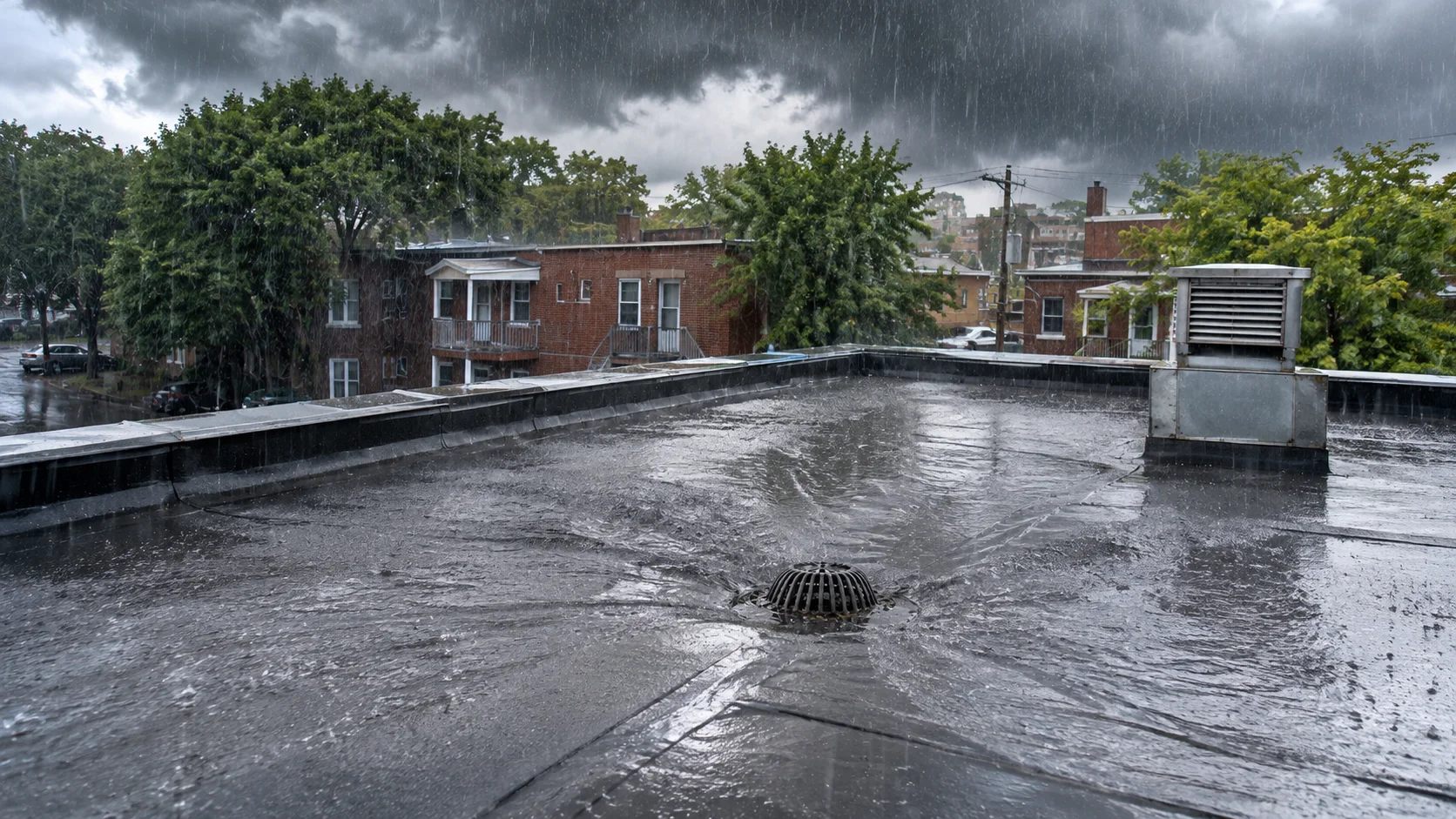
Many Montreal duplexes and triplexes were constructed with flat roofs equipped with central drains.
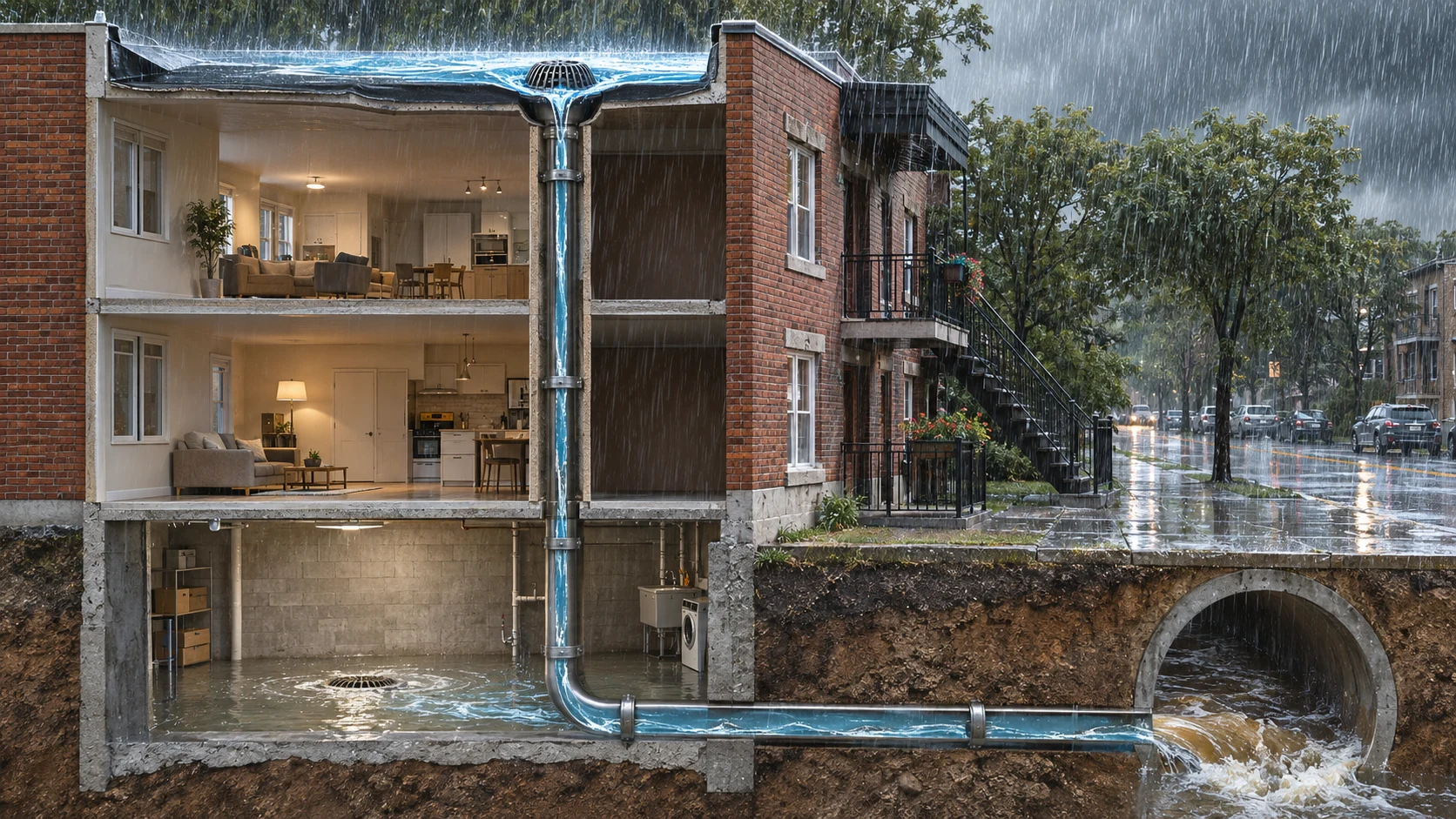
These drains collect rainwater and direct it through vertical drainage pipes, often located inside the building.
In some older properties, the roof drain eventually connects to the same underground sewer line used by toilets, sinks, showers and other plumbing fixtures.
During normal rainfall, this arrangement may function without noticeable problems.
However, during intense storms, thousands of litres of rainwater can enter the drainage system.
For example, a flat roof measuring 1,000 square feet receives approximately:
| Rainfall | Water collected on the roof |
|---|---|
| 10 mm | 929 litres |
| 25 mm | 2,323 litres |
| 50 mm | 4,645 litres |
| 75 mm | 6,968 litres |
| 100 mm | 9,290 litres |
These figures represent the approximate rainfall volume landing on the roof, before accounting for any water temporarily retained or otherwise lost.
Now imagine numerous buildings in the same neighbourhood sending similar volumes of rainwater into municipal sewers during a major storm.
This additional water contributes to the demand placed on the drainage network.
When municipal sewers become surcharged, water may no longer drain away from buildings as expected.
For homeowners who have experienced basement flooding, reducing the amount of rainwater entering their private sewer connection can become an important consideration.
2. What Does It Mean to Divert a Flat Roof Drain?
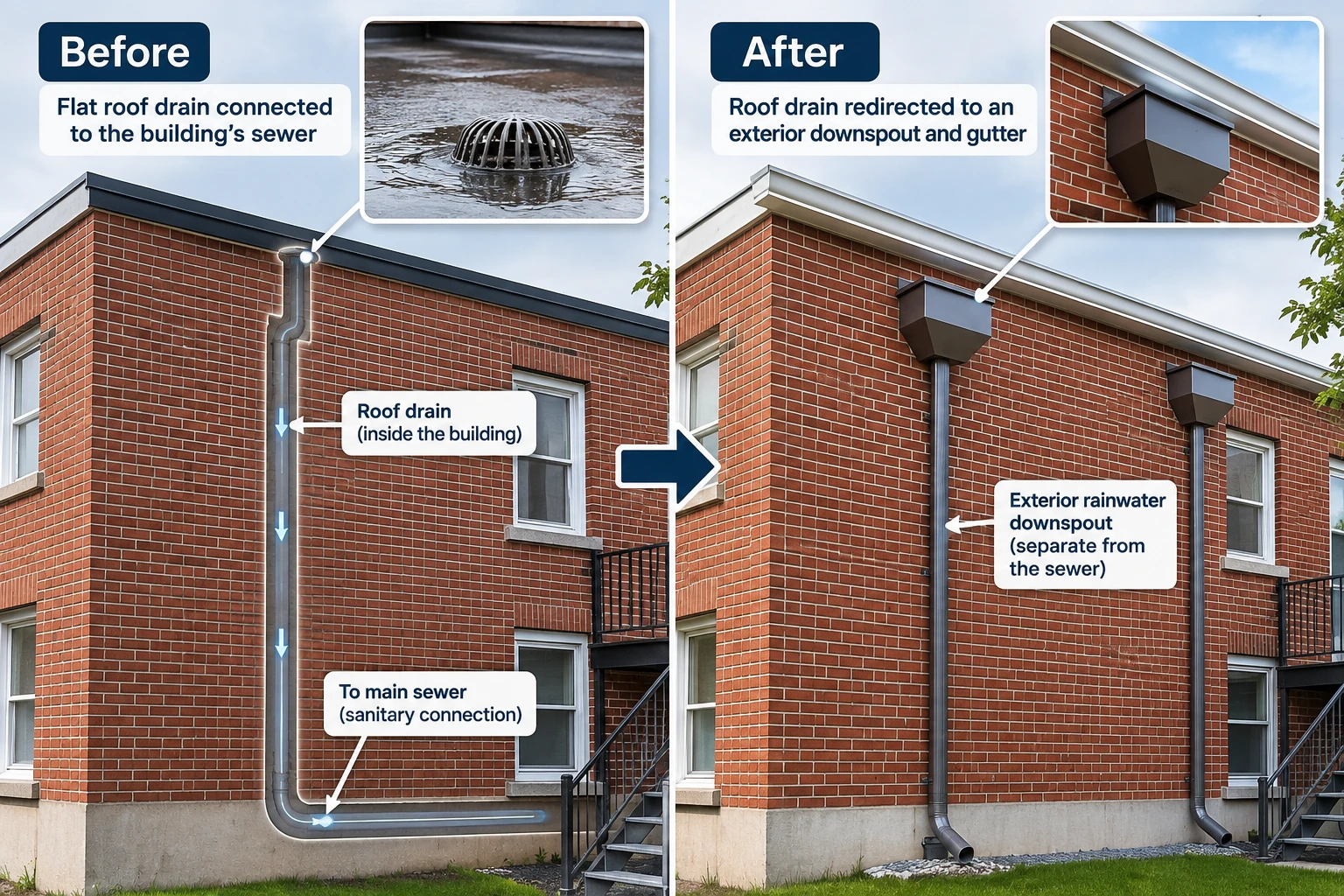
Flat roof drain diversion means changing the route that rainwater follows after entering the roof drain.
Instead of allowing roof runoff to enter an existing shared sanitary drainage connection, the objective is to direct it toward a separate, approved stormwater drainage or management system.
This can involve installing new piping, modifying existing connections or introducing stormwater storage equipment.
The goal is to reduce the volume of rainwater entering the sanitary drainage system, particularly during intense rainfall.
However, diverting a roof drain does not necessarily mean sending water directly onto the lawn or into the street.
The discharge location must be suitable for the property and comply with local municipal requirements.
3. Option One: Installing a Separate Stormwater Drainage Pipe
One approach property owners are exploring is installing an independent pipe dedicated to roof rainwater.
Rather than allowing rainwater to enter the existing sanitary sewer connection, the new pipe carries it toward an approved stormwater discharge point.
How It Works
A drainage specialist evaluates the existing roof drain and determines whether a new pipe can be routed through or along the building.
Depending on the property, this may involve:
- Connecting the existing roof drain to a new vertical stormwater pipe.
- Running piping through an interior service space or along an appropriate exterior route.
- Directing the pipe toward an approved stormwater connection or discharge system.
- Modifying existing connections to separate rainwater from sanitary wastewater.
Why Homeowners Consider This Solution
The principal advantage is that roof rainwater no longer needs to travel through the same private sanitary drainage route.
This can reduce the volume of water entering that piping during heavy storms and may help avoid certain backup situations.
What Makes It Complicated?
Many older Montreal buildings were not designed with space for separate roof drainage piping.
The existing drain may be located in the centre of the roof, with its vertical stack concealed inside walls.
Installing an independent pipe may require access through multiple floors, alterations to finished areas and coordination with roofing specialists.
The feasibility and permitted connection must be established before work begins.
4. Option Two: Redirecting Roof Rainwater to an Approved Exterior Discharge
Another approach is to redirect rainwater away from the building through an exterior drainage arrangement.
This may involve installing a new downpipe or adapting the roof drainage system to discharge toward a suitable outdoor location.
Where Can the Water Go?
Depending on municipal rules and site conditions, possible destinations may include:
- An approved landscaped drainage area.
- A properly designed infiltration system.
- An approved stormwater collection system.
- Another legally permitted discharge point.
The objective is to manage roof runoff without allowing it to accumulate against the building's foundation or flow onto neighbouring properties.
Important Considerations
This solution requires careful planning.
An improperly positioned discharge pipe can create additional problems, including foundation water infiltration, soil erosion, slippery surfaces and ice accumulation during winter.
Montreal's freezing temperatures also make exterior drainage design particularly important.
Not every flat roof or property is suitable for this approach.
5. Option Three: Installing a Rainwater Retention System
Some property owners may be able to manage roof runoff through a stormwater retention system.
Instead of immediately sending all collected rainwater into a sewer connection, a retention system temporarily stores a portion of the water.
The stored water can then be released at a controlled rate or managed through another approved method.
How Rainwater Retention Works
A properly designed system may include:
- A dedicated stormwater storage tank.
- Inlet piping connected to the roof drainage system.
- A controlled discharge arrangement.
- An overflow system designed for heavy rainfall.
- Access for maintenance and inspection.
The purpose is to reduce peak discharge during intense storms.
Is a Retention Tank Suitable for a Montreal Duplex?
Possibly, but the answer depends on the building, available space, rainfall design requirements and permitted discharge options.
A tank must have adequate capacity, a reliable outlet and appropriate overflow protection.
A storage tank that fills up without a safe way to manage additional rainwater can create its own flooding risk.
These systems require professional design rather than improvised plumbing modifications.
6. Option Four: Using a Pumped Stormwater Drainage System
Where gravity drainage is not feasible, an engineered stormwater pumping system may be considered.
This arrangement collects rainwater in a designated storage or collection chamber and uses a pump to discharge it toward an approved destination.
Why Would a Pump Be Needed?
A pump may be necessary when the approved discharge location is higher than the collection point or when the building layout prevents a practical gravity-fed connection.
A complete system may require:
- A collection basin or retention chamber.
- A pump selected for the expected water volume.
- Appropriate controls and alarms.
- A permitted discharge connection.
- Backup measures where required by the design.
What Are the Limitations?
Pumping systems depend on mechanical and electrical components.
During major storms, power failures can occur at the same time that drainage demand is highest.
For this reason, reliability, maintenance, backup provisions and emergency overflow arrangements are important design considerations.
A pumping system should not be installed without confirming that it can safely handle the expected roof runoff.
7. Why Backwater Valves Can Complicate Flat Roof Drainage
Many Montreal homeowners install backwater valves to help protect their basements against municipal sewer backups.
These valves can be effective when properly selected and installed.
However, a building with a flat roof drain connected to the main sewer can present an additional challenge.
What Happens During Heavy Rain?
Imagine a duplex where roof rainwater enters the main drainage pipe upstream of a backwater valve.
During a major storm:
- The municipal sewer becomes surcharged.
- Wastewater begins flowing backward toward the building.
- The backwater valve closes to prevent municipal sewage from entering.
- Rainwater continues entering the building's drainage system from the roof.
- The closed valve prevents that rainwater from leaving through the usual sewer outlet.
- Water can accumulate inside the building's piping and potentially back up through connected fixtures.
In this situation, the valve may be functioning correctly, but the drainage configuration creates a flooding risk.
This is one reason some homeowners investigate separating roof drainage from sanitary wastewater.
Important: Not every backwater valve installation creates this problem. The risk depends on the valve's location, the connected fixtures and the routing of the roof drainage system.
In Quebec, backwater valve installation must comply with applicable plumbing requirements. Particular care is required in duplexes, triplexes and other multi-unit buildings.
8. Can Diverting a Flat Roof Drain Prevent Basement Flooding?
Diverting roof rainwater can reduce the volume entering a shared sewer connection and may eliminate certain conflicts between roof drainage and backwater valves.
However, it is important to understand that roof drain diversion is not a guaranteed solution to every basement flooding problem.
A property may also experience flooding because of:
- Municipal sewer surcharge.
- Tree roots or other obstructions in the main sewer.
- Broken or deteriorated underground pipes.
- Improperly configured backwater valves.
- Groundwater infiltration.
- Foundation drainage problems.
For this reason, the existing sewer system should be evaluated before undertaking expensive roof drainage modifications.
A property owner may discover that the main sewer contains a restriction that requires cleaning or repair.
In other cases, the sewer may be clear, and the primary concern may be the way rainwater and wastewater are routed through the building.
Understanding the difference helps homeowners make better decisions.
9. What Should You Investigate Before Diverting Your Roof Drain?
Before hiring a contractor to modify the roof drainage system, consider the following questions.
Is the Main Sewer Partially Blocked?
A partially obstructed sewer can restrict water flow and worsen backup problems during storms.
A professional sewer camera inspection may help identify visible obstructions, roots or damaged piping.
Does the Roof Drain Connect to the Sanitary Sewer?
Not all flat roof drainage systems are configured the same way.
Determining where the roof drain connects is essential before deciding whether diversion is necessary or feasible.
Is There Already a Backwater Valve?
If a backwater valve is installed, its location and the connections it protects should be identified.
This is particularly important if roof runoff enters the drainage system upstream of the valve.
Does Flooding Occur Only During Heavy Rain?
If drainage problems occur exclusively during major storms, municipal sewer surcharge or roof drainage interactions may be contributing factors.
If problems also occur during normal household water use, a private sewer obstruction may be more likely.
What Does the Municipality Permit?
Stormwater discharge rules can differ between municipalities and building types.
Before modifying roof drainage, confirm the applicable requirements with the municipality and a qualified specialist.
10. Challenges of Diverting Roof Drains on Montreal Duplexes and Triplexes
Flat roof drain diversion is often more complicated than installing a new downspout.
Older buildings may have:
- Roof drains positioned near the centre of the building.
- Vertical drainage stacks concealed inside finished walls.
- Limited space for additional piping.
- Shared plumbing serving multiple dwelling units.
- No readily available independent stormwater connection.
- Exterior conditions that make winter drainage difficult.
A proper diversion project may involve plumbing, roofing, drainage design and municipal approvals.
Homeowners should also consider long-term maintenance.
Any new system must remain accessible and functional through Montreal's seasonal temperature changes.
11. Frequently Asked Questions About Flat Roof Drain Diversion
Why are homeowners in Montreal considering diverting flat roof drains?
Some homeowners are exploring diversion because intense rainfall can overwhelm municipal sewer systems. Separating roof runoff from sanitary drainage may reduce the amount of rainwater entering a shared sewer connection and help address certain flooding risks.
Can I redirect my flat roof drain into my backyard?
It depends on the property and municipal requirements. The discharge must not create flooding, foundation damage or drainage problems for neighbouring properties.
Can a flat roof drain be connected to a separate stormwater pipe?
In some buildings, yes. A qualified specialist must determine whether an approved stormwater connection or other suitable discharge route is available.
Can a rainwater retention tank help during heavy storms?
A properly designed retention system can temporarily store roof runoff and reduce peak discharge. Its effectiveness depends on capacity, outlet design and overflow protection.
Does a backwater valve prevent flooding from roof rainwater?
Not necessarily. If roof runoff enters the drainage system upstream of a closed backwater valve, the water may accumulate and back up through connected fixtures.
Should I clean my main sewer before considering roof drain diversion?
If there are indications of a restriction, professional sewer cleaning or camera inspection may be appropriate. A clear sewer, however, does not rule out municipal surcharge or drainage configuration problems.
Does Drain 5 Étoiles perform flat roof drain diversion?
No. Drain 5 Étoiles specializes in sewer cleaning, sewer camera inspections and applicable backwater valve services. Roof drainage diversion and independent stormwater system installations require a qualified specialist.
12. How Drain 5 Étoiles Can Help Before You Modify Your Roof Drainage
Before investing in a major roof drainage diversion project, it is worth investigating the condition of your existing main sewer.
At Drain 5 Étoiles, we help Montreal property owners identify and address sewer-related problems that may contribute to basement backups.
Our services include:
- Main sewer cleaning: Removing accessible obstructions that restrict drainage.
- Sewer camera inspections: Examining sewer pipes 4 inches in diameter and larger for visible defects and blockages.
- Backwater valve services: Assessing sewer-related valve issues and installing appropriate protection where applicable.
- Sewer troubleshooting: Helping determine whether a private sewer problem may be contributing to recurring backups.
Although we do not perform flat roof drain diversion, roofing work or independent stormwater drainage installations, investigating the existing sewer can be a useful first step before undertaking larger modifications.
Experiencing Basement Sewer Backups During Heavy Rain?
If your Montreal duplex, triplex or residential building experiences sewer backups during storms, the problem may involve more than a blocked drain.
Your roof drainage connections, existing backwater valves and municipal sewer conditions may all play a role.
Contact Drain 5 Étoiles to discuss sewer cleaning, camera inspections and backwater valve services in Montreal and surrounding areas.
Contact Drain 5 Étoiles for a sewer inspection or cleaning. Call 514-316-1043.
This article is intended for general educational purposes. Roof drainage diversion, stormwater discharge and backwater valve installations must comply with applicable Quebec plumbing requirements and municipal regulations. A qualified specialist should evaluate the proposed design before any modification is undertaken.
